

There are evenings when you come home, turn on the light — and the room stays dark. Not because of the wattage. Because of the quality.
Electric light illuminates. It explains. It shows you the room as it is — factual, complete, without interpretation. No living creature responds to a lightbulb with relaxation. The brain knows: that's a working light.
Fire, on the other hand — whether a fireplace, a cluster of candles, or a single flame on the sideboard — does something else entirely. It narrates. It turns a room into a story, a space into a scene. It's no coincidence that interior architects in Paris and Copenhagen, in Milan and Vienna, have been saying the same thing for years: The first thing I place in every project is a light source with a flame.
What's happening in 2025 is a natural consequence: Pinterest is recording a rise of over 110% for terms like «Castlecore» and dramatic candle arrangements — and the major design houses are responding with sculptural candleholders, surreal tablescapes, and handcrafted objects that elevate a flame from decoration to protagonist.
This editorial is for everyone who wants to understand how that works. Even if it's just one candle.
01 WHY FIRE /
The argument that needs no aesthetic

Before we talk about staging, we need to talk about evolution.
For 400,000 years, human beings experienced fire as the only difference between safety and danger. Between community and loneliness. Between night and place. That knowledge doesn't live in the frontal lobe — it lives much deeper. In the limbic system, where memories are stored that cannot be reasoned away.
When you light a candle this evening, the same thing happens neurologically as it did 40,000 years ago. Heart rate drops. Cortisol levels fall. The brain shifts from a state of alertness into something people once called shelter, and which science today calls «parasympathetic activation». Prettier words for the same feeling.
What this means for the home is both simple and radical: no piece of furniture in the world can replicate it. No wall mirror, no hand-woven rug, no designer sofa with a six-month lead time. A single candle on a side table does what no budget can buy — it turns a collection of beautiful objects into a place that is actually lived in.
If you could only change one thing in a room: light a candle. Not for the look. For the physiology.
02 THE VESSEL /
What holds the flame is half the statement

A candle is never "just" a candle. It is what carries it.
That sounds abstract until you've seen it once: the same candle in a water glass, and the same candle in a handmade ceramic holder whose form is unusual enough to make you look twice. The flame is identical. The effect is not.
The vessel gives the flame a posture. It decides whether fire whispers or speaks in a room. It positions the candle within the room's semantic framework — as decorative accessory or as architectural statement.
What has the interior world captivated in 2025 is the return of the sculptural. Pinterest searches for «sculptural candlesticks» have been rising for months — not because people have suddenly rediscovered the candleholder aesthetics of the 1970s, but because they understand that the holder is the real protagonist. The candle is the occasion. The object is the room.
The «Les Objets Mouleversants» collection by Serax demonstrates this with an almost audacious consistency. Inspired by the surrealist chessboard motifs of Wouters & Hendrix, hand-painted, deliberately irregular — this is not a candleholder set in the conventional sense. It's a table composition. A small tableau that happens to carry a flame.

Chessboard Candleholder Set
Serax — Les Objets Mouleversants. Hand-painted, sculptural, surreal. No shelf, no sideboard that can ignore it.
view productNever buy a candleholder that is «neutral». Neutral means invisible, and invisible means it isn't doing its actual job. A candleholder that says nothing makes the flame smaller, not larger.
03 THE SCENT /
The second fire — the one you cannot see

In our last editorial, we talked about how a room smells before you see it. What we didn't mention yet: there are candles that take that seriously — and candles that treat scent as an afterthought.
You notice the difference after an hour.
A candle poured from paraffin and dosed with synthetic fragrance oils smells like heated wax after twenty minutes. The scent note — whether vanilla, bergamot, or anything with the word «fresh» in the name — dissipates. What remains is the memory of a fragrance that was briefly there.
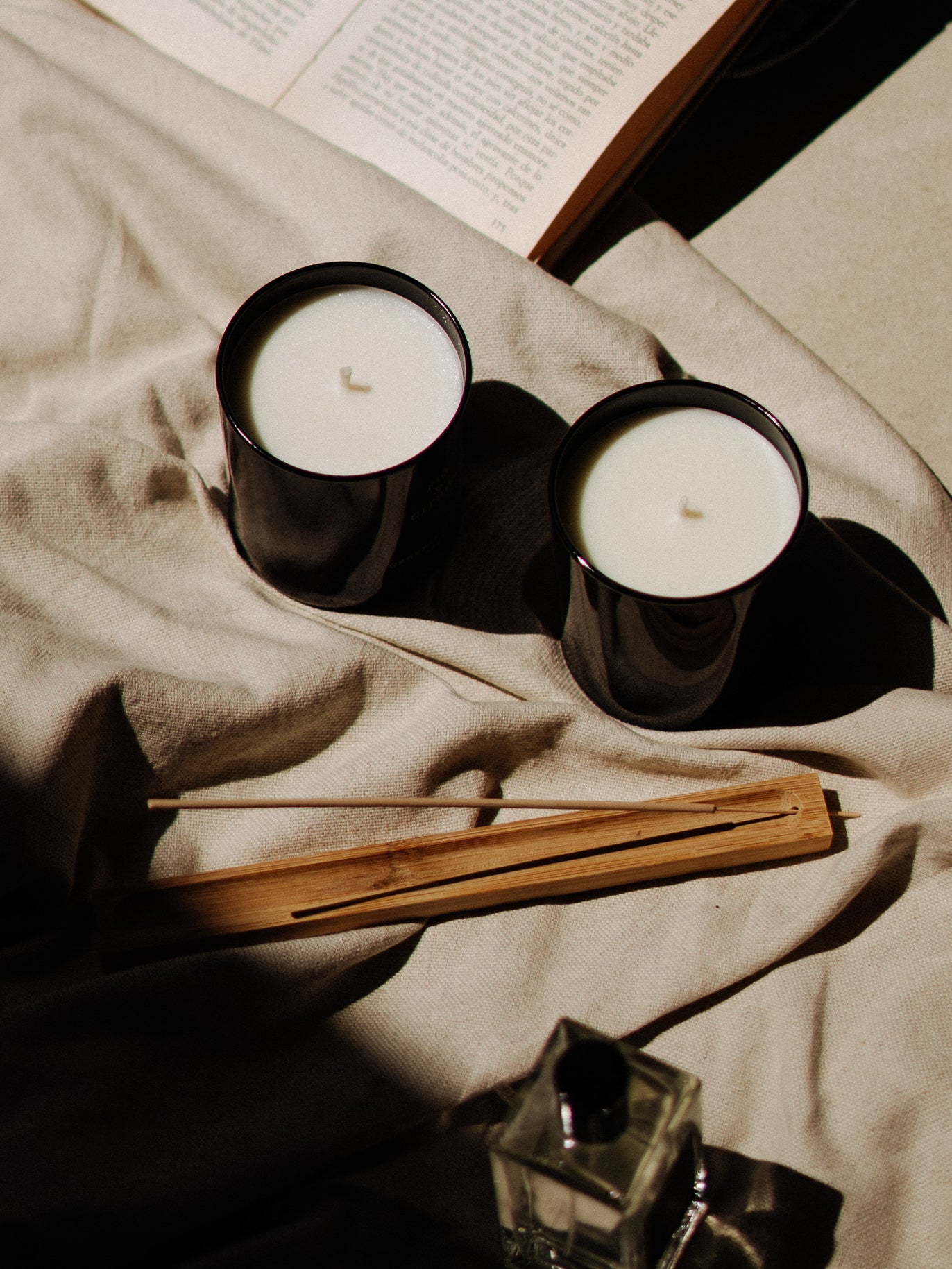
A premium candle made from soy wax with a high concentration of fragrance oil does something different. It changes the air in the room evenly, for hours, with an intensity that doesn't impose itself. You don't notice that it's burning. You only notice that the room feels different. Heavier. Quieter. More inhabited.
That's not a marketing promise. That's chemistry. A high fragrance oil content in a low-melt wax means that the aromatic compounds are released more slowly and more evenly. The brain registers no peak, no drop — only a continuous presence.
For 2025, the rule holds: the scents being discussed on Pinterest and in the ateliers of perfumers are not fresh and citrusy. They are warm, earthy, dark. Sandalwood. Oud. Tobacco and tonka. Velvet and cedar. The spirit of the moment smells inward, toward depth — notes once labelled «masculine» that today are simply called «now».


Santal & Tonka
Sandalwood & Tonka Bean. The fragrance duo that turns any room into a destination.
view productOne rule for scented candles in the living room: never burn more than one fragrance at a time. Two scents burning simultaneously almost always produce a third — and that third is rarely pleasant. One candle. One scent. One room that knows who it is.
04 THE COMPOSITION /
From solo to scene — how to scale fire

There are two mistakes people make when staging candles.
The first: too many. Twenty tea lights distributed evenly across a sideboard don't create a spectacle — they create an inventory. What's meant to suggest abundance reads as indecision. The light multiplies, but the statement divides by the same number.
The second: too symmetrical. Symmetry is the principle of the façade, not of the lived-in room. A room that breathes has imbalances. It has a centre and a periphery. It has the thing you notice first — and the thing you only discover on the second look.
The rule interior architects use for candle groupings: odd numbers, different heights, one surface with character. Three candles on a marble tray. Two candles on a wooden board with a vase beside them. A single, weighty scented candle in a handcrafted glass that speaks for itself alone.
The most compelling development in current candle aesthetics is the rediscovery of object character. Baobab Collection — founded in Belgium, handcrafted in Europe — makes candles you don't light because you need light. You light them because the vessel deserves attention. The glass of the Feathers candle, finished with a delicate feather motif, is a conversation piece even unlit. Lit, it's an experience.
And if you're ready to go one step further: the bio-ethanol fire is the logical escalation of that conviction. It is no longer a candle — it is a decision. Here, in this room, there is real fire.

Feathers Max 10
Baobab Collection. Black Rose, Oud, Saffron. A design object that happens to burn.
view product
Le Feu Black Steel High
Bio-ethanol fire. No chimney, no contractor. Just fire, the way it always was.
view product
Le Feu Mokka Ground Low
Bio-ethanol fire at floor level. Fire at eye height — that changes everything.
view productA room without any flame is complete. But it has no temperature.
What fire gives a room — whether in the form of a single soy wax candle in a sculptural holder, or in the form of an open bio-ethanol fire on the floor — is not warmth in the thermal sense. It is presence. The feeling that someone is here. That this room is actually lived in. That it exists not for photographs, but for people.
And if you don't know where to start: begin with a single candle. A scent that is warm. A holder strong enough to stand alone. That is all a room needs to transform.
— The LeCubi Editors, March 2026


0 comments